


 Français
 Español
 русский

Home / News / Industry News / Power-Driven Disc Plow: Applications, Selection Criteria, and Practical Guidance
Power-Driven Disc Plow: Applications, Selection Criteria, and Practical Guidance
Content
- 1 How a Power-Driven Disc Plow Cuts and Inverts Soil
- 2 Powered Discs Versus Passive Drawn Disc Plows
- 3 Matching Width and Disc Size to Tractor Horsepower
- 4 Disc Angle, Working Depth, and Soil Conditions
- 5 Setup Sequence for a Straight, Even Pass
- 6 When a Single Implement Cannot Finish the Job
- 7 Wear Parts, Maintenance, and the Cost per Hectare
- 8 Frequently Asked Questions
A 90 hp tractor that stalls a passive disc plow in wet clay will usually hold a steady depth with a power-driven disc plow on the same ground. The discs turn on their own power instead of relying on draft to roll them, and that single difference reshapes how the implement is sized, set up, and paid for across a season.
Power-driven disc plows sit in the primary tillage slot for growers working heavy, sticky, or residue-covered soils, and for paddy ground that has to be broken before puddling. What follows covers the drive train, width and disc matching, the setup numbers that decide field quality, and the wear points that set the real cost per hectare.
Definition: a power-driven disc plow is a mounted primary tillage implement whose disc gang is rotated by the tractor PTO through a gearbox and side drive, so the discs cut, lift, and invert soil under power rather than rolling only from ground traction.
How a Power-Driven Disc Plow Cuts and Inverts Soil
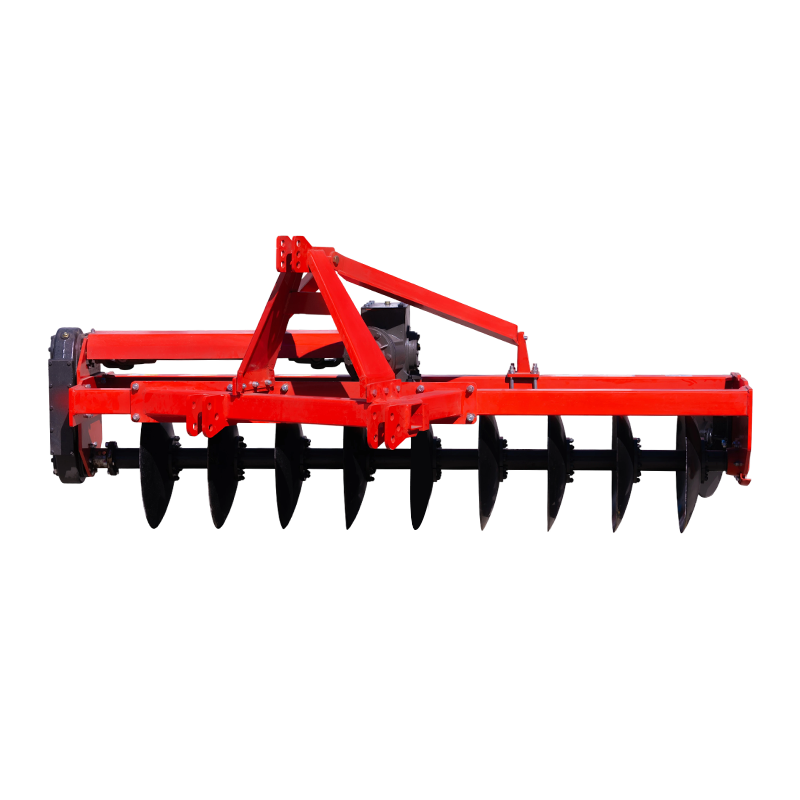
 SUNYA Power-Driven Disc Plow for Primary TillagePTO-driven disc plow uses tractor power to cut, turn, and mix heavy clay or residue-covered fields in one pass.View Product →
The PTO turns a right-angle gearbox that drives a side shaft and the disc gang, so each disc enters the soil with its own turning momentum and lifts a slice of soil up and over in one continuous motion.
A typical drive train runs from the PTO shaft, through a shear bolt or slip clutch, into the gearbox, then down a side gear case to the gang shaft. Discs are spaced along that shaft on sealed bearings, with scrapers between them to shed sticky soil. Because rotation comes from the tractor rather than from ground contact, the gang keeps turning even when the soil resists penetration.
What powered rotation changes in practice
- Heavy rice straw, green manure, and long residue are sliced and buried instead of pushed ahead of the discs.
- Plastic clay can be worked at 4 to 6 km/h without the discs smearing or skating across the surface.
- A set working depth holds in dry, hard ground where a passive disc would ride up and lose bite.
- Residue burial in a single pass leaves cleaner soil for the implement that follows.
Powered Discs Versus Passive Drawn Disc Plows
A passive disc plow relies on draft to roll its discs, so hard or wet soil stops the rotation and the implement rides over the surface. A power-driven unit keeps turning and keeps cutting, which is the whole reason the category exists.
Passive disc plow
- Rotation comes only from ground traction
- Discs skid in wet clay and hard dry ground
- Needs higher forward speed to keep rolling
- Residue tends to build in front of the gang
- Lower power demand at the PTO
Power-driven disc plow
- Rotation comes from the PTO through a gearbox
- Discs cut and lift soil regardless of traction
- Works well at 4 to 6 km/h
- Slices long straw and buries it in one pass
- Higher PTO power demand and more wear points
Practical rule: when the discs stop turning, depth control is gone. If discs ride on top of the soil, the cause is usually too shallow a disc angle, too high a travel speed, or worn steel, not a lack of horsepower.
Matching Width and Disc Size to Tractor Horsepower
As a general guide, a 1.6 m power-driven disc plow suits 55 to 75 hp, a 2.0 m unit suits 75 to 95 hp, and a 2.5 m unit suits 95 to 130 hp, all running a 540 rpm PTO.
| Working width | Disc diameter | Working depth | Tractor power | PTO speed |
| 1.6 m | 610 mm | 18 to 22 cm | 55 to 75 hp | 540 rpm |
| 2.0 m | 660 mm | 20 to 25 cm | 75 to 95 hp | 540 rpm |
| 2.5 m | 710 mm | 22 to 28 cm | 95 to 130 hp | 540 or 1000 rpm |
Width is only half of the match. Three-point category, lift capacity, and machine weight decide whether a wide plow is usable at all, and clay soils can push the power requirement up by 20 to 30 percent compared with loam. For a closer look at how gearing and adjustment interact, this field note on power-driven disc plow PTO tillage walks through the same setup logic in more detail.
Check lift capacity before you check width. A 2.5 m powered plow can weigh 700 kg or more, and if the linkage is near its limit, front ballast and a stronger top link are not optional extras.
Disc Angle, Working Depth, and Soil Conditions
Most power-driven disc plows run 35 to 45 degrees of disc angle to the direction of travel at 15 to 25 cm of depth, and they work best in clay, loam, and paddy soils rather than abrasive sands or stony ground.
Settings that change the result
- Disc angle: a steeper angle throws more soil sideways and improves inversion, but raises power demand and can push soil out of the furrow.
- Working depth: set it just below the compacted layer; running deeper than the hardpan only adds draft and wear.
- Soil moisture: plastic clay cuts cleanly, while saturated ground smears and leaves a puddled strip behind the discs.
- Residue load: heavy straw rewards a powered gang, stony ground does not.
- Frame levelling: side-to-side levelling matters more than most operators expect.
Bring a tape measure to the setup. Measure working depth in three places across the pass, and check that the frame is level before touching the disc angle.
Setup Sequence for a Straight, Even Pass
Hitch, level, and check the drive first, then set disc angle, then depth, and only then adjust the scrapers. Setting depth before the frame is level leaves a ridge that no later adjustment removes.
- Mount and level on a category II three-point linkage, check lateral sway, and set the top link so the frame sits level fore and aft.
- Inspect the drive: the PTO shaft must allow full lift without bottoming out, and the shear bolt or slip clutch must be intact.
- Equalise the disc angle on both sides using the gauge marks. Unequal angles produce a crooked pass that steering corrects all day.
- Set depth with the depth control or gauge wheels, then run 10 m and measure the real furrow depth.
- Adjust the scrapers to clear each disc by a few millimetres, so soil is shed without the scraper touching the disc.
- After the first 50 hours, check gearbox oil, retorque the disc and gang bolts, and check bearing play.
When a Single Implement Cannot Finish the Job
A power-driven disc plow breaks and inverts soil, but it deliberately leaves a rougher, cloddier surface than a rotary tiller, so it is normally a first-pass tool with secondary tillage following behind it.
On heavy clay or long-term no-till ground, the sequence that keeps working in the field is a powered disc pass at 20 to 25 cm, then a rotary tiller set shallow enough to level and blend only the top 8 to 12 cm. The disc pass does the hard work and the tiller finishes it, which keeps fuel and blade wear under control.
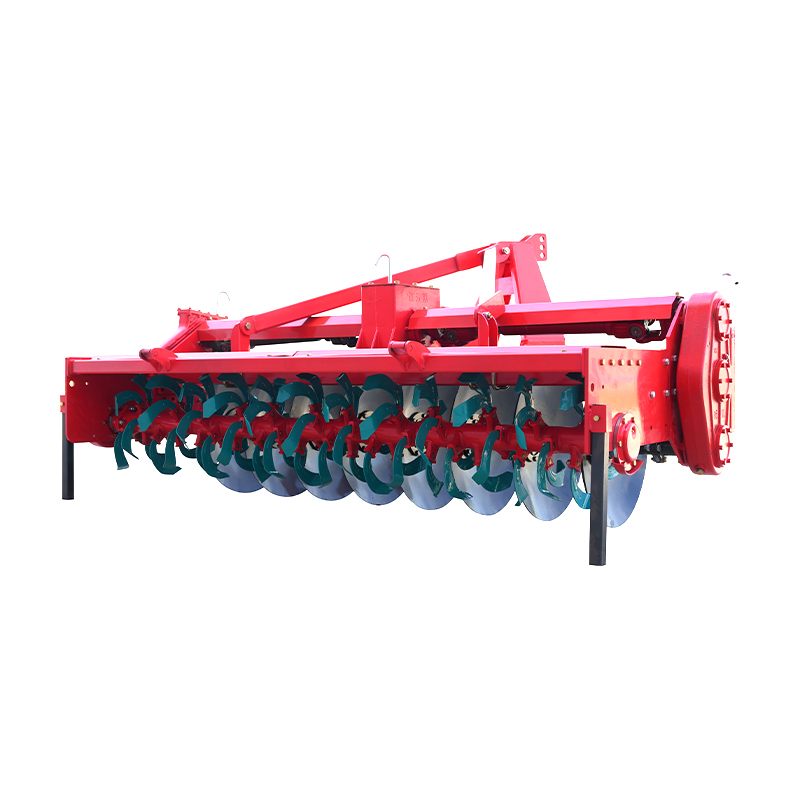
 SUNYA Full-Width Rotary Tiller for Seedbed PreparationTractor-mounted PTO rotary tiller with one-piece rotor and 200–300 cm width, suited to shallow leveling, residue mixing, and dry or wet field preparation.View Product →
Where labour and time matter more than the last few percent of seedbed quality, a combination machine that ploughs and rotovates in one pass removes an entire field operation from the schedule.
 SUNYA Disc Plow and Rotary Tiller CombinationCombination implement pairs front disc plowing with rear rotary tillage in one pass for intensive preparation of large, compacted, or heavy clay fields.View Product →
If the follow-up job is paddy work rather than dryland seedbed preparation, the same logic applies with different hardware: disc first for stubble and hardpan, then a puddler and leveller before flooding. The full land preparation range covers both single machines and combined units, so the sequence can be matched to the soil rather than to what happens to be on the yard.
One pass or two: on heavy clay, a powered disc plow followed by a rotary tiller still produces the most even seedbed. On lighter loam, a combination machine often does both in a single pass and cuts fuel and labour instead.
Wear Parts, Maintenance, and the Cost per Hectare
The recurring costs are discs, gang bearings, scraper blades, and gearbox oil, and discs and bearings normally dominate. A missed grease interval costs far more than the grease.
50 h First oil check and bolt retorque after commissioning
300-500 ha Typical disc life before replacement in abrasive soils
2 sets Spare disc and bearing sets worth keeping in the shed mid-season
Illustrative split of a season of maintenance spending
Check disc edge wear with a tape. As discs lose diameter, working depth drops with them, so a plow that suddenly runs shallow is often just worn steel rather than a setting problem.
Frequently Asked Questions
What tractor horsepower does a power-driven disc plow need?
A mounted power-driven disc plow with a 1.6 m working width typically needs 55 to 75 hp, a 2.0 m unit needs 75 to 95 hp, and a 2.5 m unit needs 95 to 130 hp on a 540 rpm PTO. Soil type matters as much as width, and heavy clay can raise the requirement noticeably compared with loam.
Can a power-driven disc plow be used in paddy fields?
Yes. Powered discs handle standing stubble and a plough pan better than passive discs, which makes them a practical first pass before puddling. After the disc pass, a paddy puddler and leveller finishes flattening and straw incorporation so the field can be flooded evenly.
How fast should the tractor travel?
Most operators work between 4 and 6 km/h. Slower speeds give the discs more time to lift and turn soil, which improves burial, while pushing past 7 km/h in heavy residue usually leaves unburied straw and a rougher surface.
How often does the gearbox need servicing?
Change the gearbox oil after the first 50 hours, then follow the interval in the manual, which is commonly each season or every 300 to 500 working hours. Check the oil for water contamination after working flooded ground, and grease the gang bearings at the interval specified for the model.
Depth, angle, and disc condition decide the pass. Horsepower only decides how wide that pass can be.

We Are Ready to Support Your Agricultural Machinery Needs
Share your requirements and we will contact you shortly with a tailored solution and professional quotation.
Copyright © Jiangsu SUNYA Machinery Ltd. All rights reserved.
 Agricultural Tillage Equipment Manufacturers in China