

 Français
 Español
 русский
Web Menu
Product Search
Exit Menu
-
+86-13815024329
-

Home / News / Industry News / Power-Driven Disc Plow: How PTO Tillage Works, Sizing, Setup, and Field Fit
Power-Driven Disc Plow: How PTO Tillage Works, Sizing, Setup, and Field Fit
Product Categories
Content
- 1 What a Power-Driven Disc Plow Actually Does
- 2 Why Active Rotation Changes the Physics of Tillage
- 3 Sizing the Plow to Your Tractor and Field
- 4 Selection Checklist Before You Order
- 5 Where a Driven Disc Plow Fits, and Where It Does Not
- 6 Setup, Wear Parts and Maintenance Rhythm
- 7 Frequently Asked Questions
A 90 hp tractor dragging a passive disc harrow through wet rice stubble does not really cut soil. The blades roll only as fast as the tractor travels, so they push, polish and smear heavy clay, and the operator ends up making three or four passes to build a seedbed that should have taken one. That specific failure is what the power-driven disc plow was designed to remove.
Drive the disc gang from the PTO and the geometry of tillage changes. Blade speed stops being a function of ground speed, cutting quality no longer collapses when you slow down for a wet patch, and residue that would choke a passive harrow is sliced and mixed instead of bulldozed into a ridge.
What a Power-Driven Disc Plow Actually Does
A power-driven disc plow is a tillage implement whose disc gang is rotated by the tractor PTO rather than by ground friction alone.
A power-driven disc plow is a PTO-driven tillage implement in which a gearbox and drive line spin the disc gang at a speed independent of forward travel, so the blades cut, lift and mix soil at a controlled rate instead of merely rolling through it.
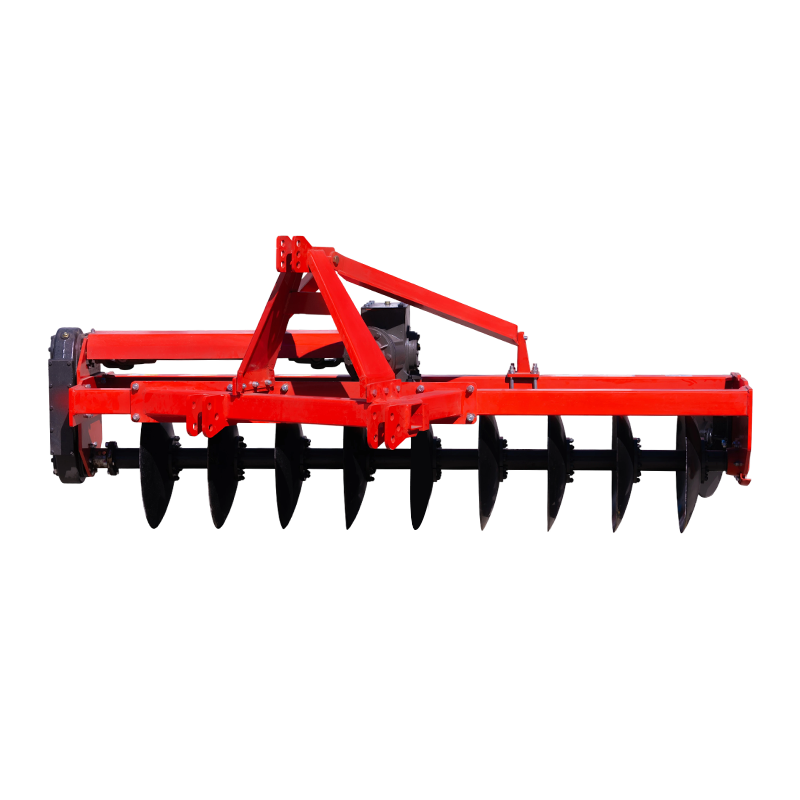
On a mounted or trailed frame, the PTO shaft feeds a gearbox, which turns the gang shaft through a chain, a gear pair or a belt. The discs are spaced along that shaft, and working depth is held by gauge wheels, a rear roller or a land wheel depending on the design. Smaller machines run a single row of discs; larger versions carry two rows set at opposing angles.
- PTO shaft with slip clutch or overrunning protection
- Gearbox and drive line rated for continuous field load
- Disc gang running on sealed or greaseable bearings
- Depth control wheels or a rear roller
- Rear levelling board, harrow or crumbler
The working principle sits closer to a rotary tiller than to a mouldboard plow, but the cutting action is different. A disc rolls through the soil, so it slices residue and lifts a slice of earth rather than chopping it against a hood. That is why a driven disc plow keeps moving in sticky clay and heavy straw where a powered rotary machine would ball up.
It also means the soil is mixed and loosened rather than fully inverted. The top layer stays closer to the surface and the moisture profile of the field is disturbed less, which matters when you are preparing ground for rice or for a root crop going in soon after.
Why Active Rotation Changes the Physics of Tillage
Active rotation decouples blade speed from travel speed, and that single change drives almost every practical advantage of the machine.
2 to 3x Typical blade tip speed relative to ground speed in working conditions
1 pass Often enough for primary tillage where a passive harrow needs three
18-30 cm Common working depth range for heavy-duty driven disc plows
540 / 1000 Standard PTO speeds the drive line is normally rated at
Cutting and fracturing soil costs energy. In a passive implement that energy comes only from forward motion, so the moment the tractor slows in a wet patch the blades slow with it and the soil starts to smear. With a driven gang the blades hold their speed and the fracture pattern survives the slow-down.
Residue handling follows the same logic. Long straw and rice stubble are carried over a rolling disc and sliced, while a tine or a rotary hood drags them into a plug. That is the main reason driven disc plows are common in paddy regions where the previous crop leaves a heavy mat on the surface.
A driven gang needs power for rotation as well as for draft, so lowering forward speed does not lower fuel demand the way it does with a passive harrow.
Moisture is the third effect. A fully inverted profile dries out faster. A mixed profile holds more moisture in the working layer, which helps in a dry spell and hurts if the ground is already too wet to carry the tractor.
Sizing the Plow to Your Tractor and Field
Size the machine by the working width you can pull at the depth you need, not by the widest model the catalogue lists.
| Field condition | Working width | Tractor class | Working depth | Main risk |
| Paddy stubble, heavy clay | 1.8-2.4 m | 90-130 hp | 18-25 cm | Residue wrapping the gang |
| Dryland clay, primary tillage | 2.0-2.6 m | 110-150 hp | 20-30 cm | Draft spikes in dry soil |
| Ridge forming for root crops | 1.2-1.8 m | 60-90 hp | 15-25 cm | Uneven ridge profile |
| Secondary tillage after harvest | 2.2-3.0 m | 80-120 hp | 10-18 cm | Over-working moist soil |
Two things shift these numbers. A driven gang demands power even when the tractor is barely moving, so a machine a 110 hp tractor handles in dry clay can overload the same tractor in wet clay at walking pace. Weight matters as much as power, because the gang needs enough downforce to hold depth without bouncing.
A useful rule is to match the gearbox rating to the tractor's PTO output with some margin, then check that the three-point linkage or drawbar can carry the machine's weight with the discs in the ground. If you cannot lift it clean out of the soil at the headland, the machine is too heavy for the tractor.
Selection Checklist Before You Order
Six details separate a driven disc plow that lasts a decade from one that spends the season in the workshop.
- Disc diameter and plate thickness. A larger disc reaches deeper and clears residue better, while thickness decides how long it survives stones and hard dry clods.
- Bearing housing and sealing. Gang bearings live in soil and water, so a triple-lip seal or a maintenance-free sealed unit is worth the extra cost.
- Gearbox and drive line rating. Ask for the rating in kW at a stated PTO speed, and confirm that a slip clutch or shear bolt protects the drive line.
- Depth control method. Gauge wheels, a rear roller and a land wheel behave differently on soft paddy soil; a roller also levels the surface behind the discs.
- Hitch category and offset. Confirm the machine matches your tractor's category and that the offset keeps the tractor out of freshly tilled ground.
- Wear parts and lead time. Discs, bearings and seals should be standard items with a realistic delivery window, because one seized bearing can stop a whole field operation.
Ask for the drive line rating in kW at a stated PTO speed rather than horsepower alone. A gearbox rated at 540 rpm tells you nothing useful until you know the engine speed your tractor actually holds under load.
Where a Driven Disc Plow Fits, and Where It Does Not
A driven disc plow earns its cost in heavy, wet or residue-covered ground, and rarely pays for itself in light, stone-free soil.
Strong fit
- Heavy clay and paddy soil after rice harvest
- Fields carrying long straw or a thick residue mat
- Ridge building for potatoes and other root crops
- Contractors who need primary tillage in one or two passes
- Ground that must be worked soon after rain
Weak fit
- Stony ground where discs chip and bend
- Light sandy soil a passive harrow already handles
- Small compact tractors with limited PTO output
- Single-pass fine seedbed for vegetables
- Ground so wet that any traffic causes rutting
The implement does not replace agronomy. If a field is too wet to carry the tractor, a driven disc plow will still make ruts, only faster ones.
Setup, Wear Parts and Maintenance Rhythm
Most driven disc plow failures trace back to bearing neglect and drive line overload, and both are preventable with a short routine.
Before the season
Check gang end play, gearbox oil level, slip clutch setting and disc edge condition. Replace any disc that has lost a visible amount of diameter, because worn discs raise draft and leave uncut strips.
First 10 working hours
Re-torque gang and frame bolts and inspect seals for weeping grease or muddy oil. New machines settle into their load pattern in the first days of work.
Every 50 hours
Grease every point the manufacturer lists, check drive line guards and shaft splines, and measure bearing play by hand. A warm bearing housing after a short run is an early warning.
End of season
Wash the machine, lubricate all points, inspect bearing play and store the frame with the discs clear of the ground so moisture does not sit against the edges.
A seized gang bearing usually takes the shaft, the housing and sometimes the disc with it. Greasing on schedule costs a fraction of that repair, and it is the cheapest insurance on the whole implement.
Frequently Asked Questions
Short answers to the questions buyers ask most often before placing an order.
What tractor power does a power-driven disc plow need?
There is no single number, because a driven gang needs power for rotation as well as for draft. As a working guide, 60-90 hp suits widths around 1.2-1.8 m for ridge work, 90-130 hp suits 1.8-2.4 m in paddy conditions, and 110-150 hp is realistic for 2.0-2.6 m in dryland clay. Compare the gearbox rating with your tractor's PTO output at the rated PTO speed.
Is a power-driven disc plow the same as a rotary tiller?
No. Both are PTO driven, but a disc gang rolls through the soil and slices it, while a rotary tiller cuts with blades against a hood. The disc version handles long residue and sticky clay with less wrapping, needs a different power curve, and leaves a coarser, more mixed surface.
How deep should I run a driven disc plow?
Start shallow, at roughly half the disc diameter, and increase in steps while watching engine load and the surface left behind. Most heavy-duty driven disc plows work comfortably between 15 and 30 cm depending on disc size, soil moisture and tractor power. Working deeper than the machine can hold steadily produces an uneven seedbed.
What wears out first on a driven disc plow?
Gang bearings and seals, followed by disc edges and the drive line. Bearings fail early when grease intervals are missed or when the machine works in waterlogged soil without a proper seal. Discs wear at the outer edge and lose diameter, which reduces working depth and cutting quality.
Buying a power-driven disc plow is a decision about ground conditions more than about catalogue numbers. If your fields carry heavy residue, sit wet for long periods, or need primary tillage in a single pass, the driven gang earns back its cost through fewer passes and steadier work. If your soil is light, dry and already easy to work, a passive implement will do the same job for less money and less maintenance.
Whichever way you go, ask for the drive line rating at a stated PTO speed, confirm that discs and bearings are standard stock items, and match the working width to what your tractor can pull at depth rather than to what looks impressive on paper.
RELATED PRODUCTS

We Are Ready to Support Your Agricultural Machinery Needs
Share your requirements and we will contact you shortly with a tailored solution and professional quotation.
Product
Newsroom
Copyright © Jiangsu SUNYA Machinery Ltd. All rights reserved.
 Agricultural Tillage Equipment Manufacturers in China