


 Français
 Español
 русский

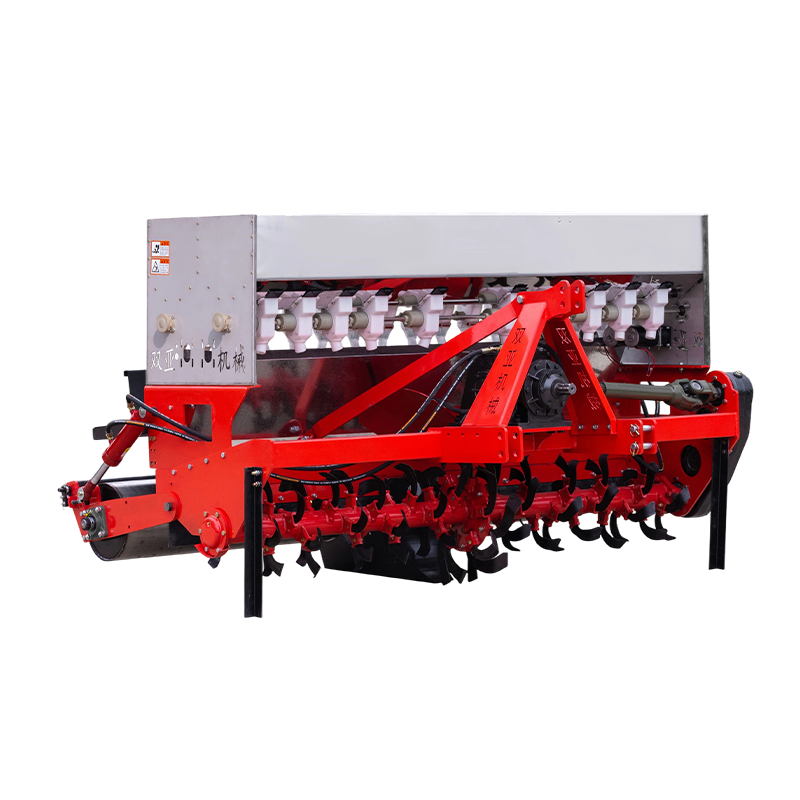


Jiangsu SUNYA Machinery Ltd. manufactures tractor-mounted implements that prepare soil, open furrows, place fertilizer and seed, cover and consolidate in one pass. Our Tillage, Furrowing, Seed & Fertilizer Drill manufacturer line is built for mechanized and large-scale establishment of wheat, rice and soybeans, where separate tillage and planting trips cost time, moisture and fuel. Every machine is produced in our 20,000 m² facility in Jiangsu and shipped to farms, distributors and importers worldwide.
- Working width: 200–300 cm across five standard models
- Furrow / trenching depth: 10–20 cm, adjustable
- Tractor requirement: 70–140+ HP (52–104 kW), three-point hitch and PTO drive
- Single-pass functions: residue separation, soil breaking, furrow opening, fertilizer placement, seeding, covering, compaction, ridging
- Blade arrangement from 48 + 12 + 4 (12KG-200) to 72 + 12 + 4 (12KG-300)
- Hydraulically adjustable stainless steel ground wheels for compaction control
The Combined Pass, Step by Step
The Seed Cum Fertilizer Drill is a combined agricultural implement rather than a seeder alone. Tillage, furrowing, fertilizing, seeding, covering and compaction are sequenced inside one frame, so the seedbed is prepared and planted before the soil dries or re-compacts.
Residue separation and seedbed preparation
Tillage and furrowing components cut and loosen the soil while separating straw and root residues, leaving a clean strip for the fertilizer and seed openers. This is the part of the pass that decides whether establishment is even across the field.
Furrow opening and depth control
Trenching components form furrows with smooth edges and effective trench cleaning, and the working depth is set between 10 and 20 cm to suit the crop and the moisture profile. Soil from the furrow is distributed evenly by the soil-turning blade.
Fertilizer and seed placement
Fertilizer and seed are placed into the prepared furrow at the row spacing and seeding depth configured for the crop. Because both materials enter a freshly worked, residue-free band, placement is more consistent than in a separate drilling pass over untilled ground.
Covering, compaction and ridging
Covering and press-wheel compaction close the furrow and provide seed-to-soil contact that conserves moisture for uniform emergence. The hydraulically adjustable stainless steel ground wheels let the operator change compaction force on the move; ridging completes the pass where the field layout calls for it.
Our Tillage and Land Preparation Range
Drill projects rarely stand alone. We supply the surrounding tillage and land preparation equipment from the same factory, which keeps hitch geometry, working depth and tractor matching consistent across a fleet.
| Range | Primary function | Where it fits in a planting programme |
|---|---|---|
| Rotary Tiller | Tractor-mounted powered tillage | Primary or secondary seedbed work ahead of drilling, or on land where the combined drill is not used |
| Power-Driven Disc Plow | PTO-driven disc tillage | Deep loosening and residue handling on heavier soils before a seeding pass |
| Disc Plow & Rotary Tiller Combination | Two tillage operations in one frame | Fields needing deep work plus a fine tilth in a single trip |
| Paddy Puddler & Leveler | Puddling and levelling for paddy | Field preparation on rice ground before transplanting or wet seeding |
| Bund Former | Ridge and bund shaping | Field division and ridge formation around the planting layout |
| Rotary Ditcher | Trenching and drainage channels | Drainage and irrigation channels alongside the drilled area |
12KG Model Range, Working Width and Tractor Matching
The combined drill is offered in five standard widths. All models run a 10–20 cm trenching depth and use the same three-point hitch and PTO arrangement; the blade count and frame width scale with the tractor class.
| Model | Working width (cm) | Overall dimensions (cm) | Trenching depth (cm) | Matching horsepower | Blades |
|---|---|---|---|---|---|
| 12KG-200 | 200 | 162 × 240 × 162 | 10–20 | 70–90 | 48 + 12 + 4 |
| 12KG-230 | 230 | 162 × 270 × 162 | 10–20 | 80–100 | 56 + 12 + 4 |
| 12KG-250 | 250 | 162 × 290 × 162 | 10–20 | 90–120 | 60 + 12 + 4 |
| 12KG-280 | 280 | 166 × 320 × 162 | 10–20 | 110–140 | 68 + 12 + 4 |
| 12KG-300 | 300 | 166 × 340 × 162 | 10–20 | Above 140 | 72 + 12 + 4 |
The standard build is described on the Tillage, Furrowing, Seed & Fertilizer Drill Combination specification, including hydraulic ground-wheel adjustment, soil distribution through the turning blade and clean-edged trenching components.
Application Fit: Crops, Soils and Field Layout
The combined drill is aimed at wheat, rice and soybean planting where land preparation and planting can be merged into one mechanized operation. It suits large, regularly shaped fields worked by tractors in the 70–140+ HP band, and it performs best when the operator can commit to a consistent forward speed and depth setting.
- High-residue ground: the residue separation stage keeps straw and roots out of the seeding band.
- Heavier and moisture-retentive soils: powered tillage and furrowing cope with ground that a plain seed drill cannot open cleanly.
- Paddy and paddy-upland rotations: matched with our paddy preparation equipment where fields alternate between rice and dry crops.
- Moisture-critical sowing windows: covering and press-wheel compaction immediately behind the openers limit moisture loss after the furrow is closed.
Where a project needs a different sequence — for example ploughing before a lighter seeding pass — our rotary tiller range and combination tillage machines cover the preparation stage separately.
Configuration Options We Build Around
Custom production is a core part of what we do, and a number of our overseas models started as customer-specific adaptations. Within the combined drill family we adjust the following parameters during configuration.
- Working width and frame layout for the available tractor class
- Working depth range and furrow geometry for the target crop
- Blade shaft, blade angle and blade count
- Gearbox ratio matched to tractor power and PTO characteristics
- Reinforced versions for stony or harsh field conditions
- Row spacing and seeding depth settings matched to the crop protocol
- Compaction control through hydraulically adjustable stainless steel ground wheels
- Ridging and bund-forming elements where the field layout requires them
Development is based on drawings, samples or a written description of the farming conditions, and we manufacture mechanical parts such as blades, harrow tines and bearings alongside the complete machines.
Tractor Interface, Hydraulics and Installation
The machine mounts on the tractor three-point hitch and is driven from the rear PTO, so no separate power source is needed in the field. The hydraulic service that operates the adjustable ground wheels comes from the tractor's own circuit.
- Confirm tractor model, rated power and PTO type before the gearbox ratio is fixed
- Confirm the number and flow of hydraulic outlets available at the rear of the tractor
- Check lift capacity and category of the three-point linkage against the model weight
- Commissioning covers hitch height, depth setting, furrow alignment and ground-wheel pressure
- Operator instruction covers depth adjustment, compaction setting and safe working around the powered shaft
Quality Control, Documentation and Acceptance
Every manufacturing step — welding, machining and painting — is inspected by trained personnel, and all finished machines go through 100% final inspection against the agreed specification before packing. Key components are reinforced for wear resistance in heavy-duty, high-frequency operation.
| Project stage | What we confirm |
|---|---|
| Configuration | Model, working width, depth range, blade arrangement, gearbox ratio, hydraulic requirements |
| Production | In-process inspection at cutting, welding, machining, coating and assembly; ERP-tracked order progress |
| Final inspection | 100% testing of finished machines against customer specification and international standards |
| Packing and loading | Standardized export packaging and container loading plan |
SUNYA holds National High-Tech Enterprise status, operates a provincial postgraduate R&D station, and develops agricultural technology jointly with universities. Patent certificates cover utility model, design and invention registrations.
Information We Use to Configure Your Solution
To return a workable configuration and quotation, we work from the following project inputs. The more precise the field data, the closer the first configuration will be to the final machine.
- Crop, target row spacing and required seeding depth
- Fertilizer type, application rate and placement preference
- Soil type, residue level and typical field conditions
- Field size, shape and expected daily or seasonal area
- Tractor make, model, rated power, PTO and hydraulic outlets
- Preferred working width and any transport-width restrictions
- Depth range and any need for ridging or bund shaping
- Destination port, packaging requirements and order quantity
On business days we respond to inquiries within 12 hours and confirm trade terms such as FOB or CIF during quotation. Machines ship mainly by sea freight from Lianyungang Port, roughly 50 km from our facility, with air freight available for urgent shipments.
Wear Parts, Spares and Serviceability
The wearing elements on a combined drill are the blades and the soil-engaging components, and they are accessible from the frame without dismantling the drive train. We manufacture blades, harrow tines and bearings ourselves, so replacements are supplied on the same specification as the original machine.
- Spare blades, tines and bearings can be included in the initial order or shipped separately
- Gearbox, shaft and frame components are built for repair rather than replacement of the whole assembly
- Field adjustments — depth, ground-wheel pressure and furrow alignment — are carried out with standard tools
Frequently Asked Questions
Which field operations does the combined drill complete in one pass?
Tillage, residue separation, soil breaking, furrow opening, fertilizer placement, seeding, covering, compaction and ridging. The result is a prepared, planted and consolidated strip in a single trip across the field.
How do I choose between the 12KG-200 and the 12KG-300?
The choice follows tractor power and the required daily area. The 12KG-200 at 200 cm suits 70–90 HP, while the 12KG-300 at 300 cm requires above 140 HP. All five models share the same 10–20 cm trenching depth, so width and horsepower are the deciding variables.
Can the machine be adapted to our row spacing, soil and tractor?
Yes. Working width, working depth, blade shaft, blade angle, gearbox ratio and frame reinforcement are all configured to the project. We develop from drawings, samples or a description of the local farming conditions.
How is compaction controlled after seeding?
Hydraulically adjustable stainless steel ground wheels let the operator increase or reduce compaction force as soil moisture and residue conditions change through the day.
What is included with an exported machine?
The machine is supplied with a configuration matched to your tractor, standardized export packaging and a container loading plan. Trade terms, spare-part content and documentation requirements are agreed during quotation.