

 Français
 Español
 русский
Web Menu
Product Search
Exit Menu
-
+86-13815024329
-

Home / News / Industry News / Seed Cum Fertilizer Drill: Specifications, Calibration and Buying Guide
Seed Cum Fertilizer Drill: Specifications, Calibration and Buying Guide
Product Categories
Content
- 1 What a Seed Cum Fertilizer Drill Actually Does
- 2 The Parts That Decide Accuracy
- 3 Specifications Worth Confirming Before You Order
- 4 Calibration: The Half Hour That Sets the Season
- 5 One Pass or Two: A Straight Comparison
- 6 Matching the Machine to the Farm
- 7 Between-Season Care
- 8 Frequently Asked Questions
A seed cum fertilizer drill only earns its keep when the material leaving the tubes matches the rate on the calibration chart. A fluted roller worn by half a season, a damp fertilizer blend, or a faster forward speed can each shift the real rate several percent away from the setting, and nothing applied later in the season brings that seed back.
Buyers tend to compare these machines on price, row count and hopper volume. The differences that decide a harvest sit elsewhere: how the metering rollers are driven, whether seed and fertilizer rates adjust independently, how quickly the openers choke in damp soil, and how repeatable the settings stay from one field to the next.
What a Seed Cum Fertilizer Drill Actually Does
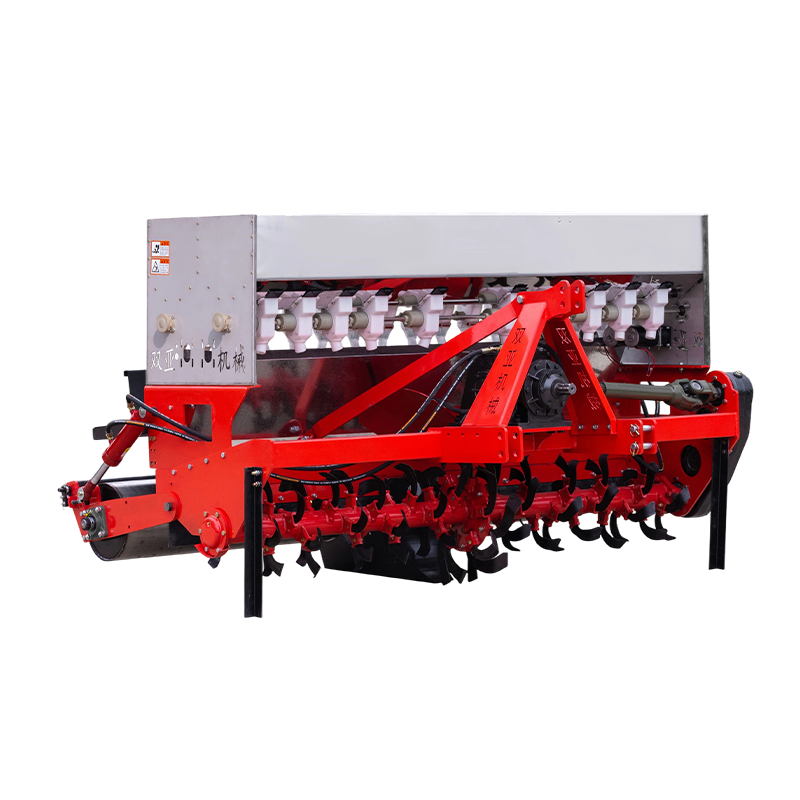
A seed cum fertilizer drill is a tractor-drawn implement that opens furrows, meters seed and fertilizer from separate hoppers, and places both at a controlled rate and depth in a single pass.
The machine does not prepare a seedbed. It is built for ground that has already been tilled and levelled, which is why it is normally scheduled straight after a rotary tiller or a disc plow in the same working programme.
Common configurations run from 9 to 13 furrow openers, matched to a tractor of roughly 35 hp and above. Each opener cuts a narrow trench, a seed tube drops metered seed behind it, and a second tube places fertilizer either in the same row or in a band beside it.
9-13 Furrow openers
35 hp+ Minimum tractor power
224-328 kg Machine weight range
In rice-based systems the same drill family runs alongside puddlers and levellers, because uneven land forces the openers to work at inconsistent depth, and depth is what decides whether a crop emerges evenly or in patches.
The Parts That Decide Accuracy
Metering quality, not steel thickness, is what separates a drill that holds its rate from one that drifts across the field.
- Seed box and fertilizer box. On combined machines these are either two separate hoppers or one long box split lengthwise into two compartments, so seed and fertilizer never share a metering path.
- Seed metering mechanism. A fluted roller sits at the bottom of the seed box, collects grain in its longitudinal grooves, and releases it into the seed tube. Sliding the roller sideways changes how much groove is exposed.
- Fertilizer metering mechanism. Gravity feed or a corrugated roller, depending on the blend and the rate required.
- Furrow openers. Reversible shovel types are the common choice, since a worn or blunt shovel changes both the depth and the soil flow around the seed.
- Seed and fertilizer tubes. Short, straight runs deliver more consistently than long curves, especially at high rates.
- Power transmission. Chain and sprockets driven from the ground wheel keep the metering rate tied to distance travelled rather than engine speed.
- Rate adjusting lever. The single control that changes seed delivery without swapping rollers.
The fluted roller is where nearly all seed-rate error originates, and it is also the cheapest part to inspect and replace. Measure groove depth on the outer rollers first, because they usually wear faster than the centre ones.
Specifications Worth Confirming Before You Order
Confirm five figures before signing anything: working width, row count, seed box capacity, machine weight, and the minimum tractor power the maker states for the row count you are buying.
| Parameter | Typical range | Why it matters |
| Tractor power | 35 hp and above | Lift capacity and traction both scale with row count and hopper load |
| Row count | 9 to 13 openers | Sets the working width and the daily area you can cover |
| Overall length | 1940 to 2310 mm | Affects turning radius at headlands and transport width |
| Machine weight | 224 to 328 kg | Empty weight plus full hoppers decides the required rear lift |
| Seed metering | Fluted roller type | Determines achievable accuracy on small and large seeds |
| Fertilizer metering | Gravity feed or corrugated roller | Granular blends flow differently from prilled products |
| Power transmission | Chain and sprockets | Keeps the rate tied to ground distance, not engine speed |
| Furrow opener | Reversible shovel | Replaceable tips keep depth consistent across a season |
9 rows 1.8 m
11 rows 2.2 m
13 rows 2.6 m
Working width at a 20 cm row spacing, which is the figure you multiply by forward speed to estimate hectares per hour. A 2.2 m drill moving at 5 km per hour covers roughly 1.1 hectares in an hour of uninterrupted work.
Calibration: The Half Hour That Sets the Season
Calibrate the seed side and the fertilizer side separately, and recalibrate both whenever you change seed lot, fertilizer blend, or target rate.
- Mark the ground-drive wheel with a chalk line and measure its circumference. Work out how many wheel revolutions equal one hundredth of a hectare at your working width.
- Jack the machine so the drive wheel turns freely, and place collection bags or trays under every seed tube outlet.
- Fill the seed box to a normal working level. Testing with a nearly empty box gives a number that means nothing in the field.
- Turn the drive wheel the calculated number of revolutions at a steady pace, then weigh everything collected.
- Compare the weight against the target for that area, and correct the rate using the adjusting lever. Re-run the test after every adjustment.
- Repeat the whole procedure for the fertilizer box, separately. The two rates are independent and must be verified independently.
- After the first field pass, stop and check actual seed spacing in the row and the distance between the seed band and the fertilizer band.
The collected weight from a one hundredth hectare test is real grain and real fertilizer. Everything downstream of that number is arithmetic, and arithmetic does not gamble with a season.
One Pass or Two: A Straight Comparison
Combining tillage, sowing and fertilizing into a single pass removes one field operation, but it also loads the seed row with risks that separate operations never carry.
Separate passes
- Two machines and two trips across the field
- Higher fuel and labour cost per hectare
- Double the traffic, so more soil compaction
- Fertilizer placement is easier to keep away from the seed
- Easier to hit a precise seed rate on a light seedbed
Single pass with a combined drill
- Opens, sows and fertilizes in one pass
- Fewer wheel tracks and better moisture retention
- Seed and fertilizer placed in the same operation window
- Heavier machine, so more tractor lift capacity needed
- Placement separation between seed and fertilizer becomes critical
Keep the fertilizer band roughly 5 cm to the side of and 5 cm below the seed row. Direct seed-to-fertilizer contact raises salt concentration around the germinating seed, and the damage is worst on light soils and with high-analysis blends.
Matching the Machine to the Farm
Row count should follow your tractor, not the other way around.
Before choosing a width, work through four questions: what can the rear linkage lift when the hoppers are full, how many hectares must be covered inside the sowing window, how even is the land after primary tillage, and who supplies fluted rollers and opener tips within reach of your workshop.
For buyers working across different soil and crop conditions, the practical advantage lies with manufacturers who run their own fabrication rather than assembling bought-in parts. A maker that handles cutting, welding, machining, coating and final assembly in one facility controls thickness, tolerance and paint quality directly, and can respond to configuration requests without waiting on outside subcontractors.
Manufacturing scale is a reasonable proxy for whether spare parts will still exist in five years. A producer running six production lines and an annual output above 2000 complete machines has both the tooling and the incentive to keep consumable parts in stock for markets it already serves.
Established exporters in this category typically cover Southeast Asia, South America, Russia, the Middle East and Africa, with equipment lines that extend beyond the drill itself to rotary tillers, paddy puddlers and levellers, bund formers and rotary ditchers. That matters when you want a matched set of implements rather than a single machine that works well only on its own. Suppliers operating on a stated principle such as quality wins the market and integrity builds partnerships are usually the ones that treat a parts list as part of the sale rather than an afterthought.
Between-Season Care
Empty and rinse the fertilizer box first, because residual fertilizer corrodes a drill faster than a full season of field work ever will.
- Flush both hoppers with clean water and let them dry fully before closing the lids.
- Inspect fluted rollers for groove wear and replace any that no longer hold a consistent depth.
- Check chain tension and lubricate sprockets at the start of storage, not in the spring.
- Measure opener tips; a blunt shovel changes both trench depth and soil cover.
- Confirm that every seed tube is clear and seated properly on its opener.
- Store the machine under cover with the openers lifted clear of the ground.
A rough rule that holds up in practice: replace rollers and opener tips as a full set rather than one at a time, because a mixed set of worn and new parts produces a row-to-row rate difference you cannot correct with the adjusting lever.
Frequently Asked Questions
What is the difference between a seed drill and a seed cum fertilizer drill?
A plain seed drill meters and places seed only. A seed cum fertilizer drill carries two metering systems and two hoppers on the same frame, so seed and fertilizer are placed in one pass at independently adjustable rates.
How many rows can a 35 hp tractor handle?
Nine openers is the practical starting point for a 35 hp tractor, and that assumes the machine is not carrying a full fertilizer load on wet ground. Beyond that, rear lift capacity and traction decide the limit more than engine power does.
Can I put seed and fertilizer in the same furrow?
It is possible but risky unless the fertilizer is placed beside and below the seed. A separation of roughly 5 cm laterally and 5 cm vertically is the usual target, particularly with high-analysis fertilizers and light soils.
How often should the drill be calibrated?
At the start of every season, after any change of seed lot or fertilizer blend, and at the start of each sowing window once the machine sits idle over winter. If output seems off mid-season, check roller wear before touching the rate lever.
RELATED PRODUCTS

We Are Ready to Support Your Agricultural Machinery Needs
Share your requirements and we will contact you shortly with a tailored solution and professional quotation.
Product
Newsroom
Copyright © Jiangsu SUNYA Machinery Ltd. All rights reserved.
 Agricultural Tillage Equipment Manufacturers in China